
Menu
Samantha
October 6, 2026
Do you have students who know they need to regroup, but can’t explain what regrouping actually means? Maybe they can follow the steps when you model it, but they can’t explain why the numbers change. Or maybe regrouping itself still isn’t clicking at all.
That’s when I’d pull out the base ten blocks.
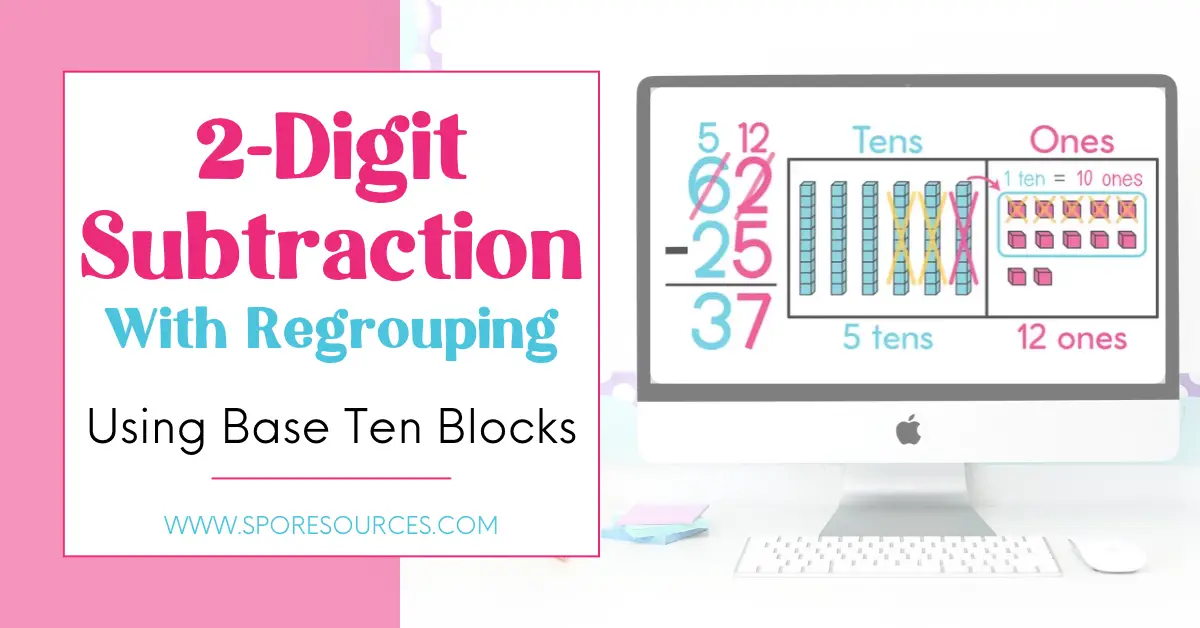
Using base ten blocks for 2-digit subtraction with regrouping gives students a way to actually see what is happening when they regroup. Instead of memorizing a set of steps, they can physically take one ten, regroup it as 10 ones, and connect that model to what they write in the standard algorithm.
Let’s walk through 2-digit subtraction with regrouping using base ten blocks with the problem:
62 − 25
Before I start teaching 2-digit subtraction with regrouping using base ten blocks, I’d first make sure students have a solid understanding of place value.
For 62, students need to understand that the 6 does not just mean “6.” It represents 6 tens, or 60. The 2 represents 2 ones.
One of the first questions I might ask is:
“Look at the number 62. How many tens and how many ones do you see? How do you know?”
I’d also want students to understand that 1 ten has the same value as 10 ones.
That relationship is what makes regrouping work.
If that idea is still shaky, I wouldn’t rush into the subtraction yet. Unifix cubes (or other connecting cubes) can be useful here because students can physically build a group of 10 and then break it back apart into 10 individual ones.
If your students have already used base ten blocks for addition with regrouping, this is a nice connection to make. In addition, students can compose 10 ones to make 1 ten. In subtraction, they’re doing the reverse: decomposing 1 ten into 10 ones when they need more ones to subtract.
How to Teach 2-Digit Addition With Regrouping Using Base Ten Blocks
The goal is for students to understand that we are changing how the number is represented, not its value.
For this example, we’ll solve 62 − 25.
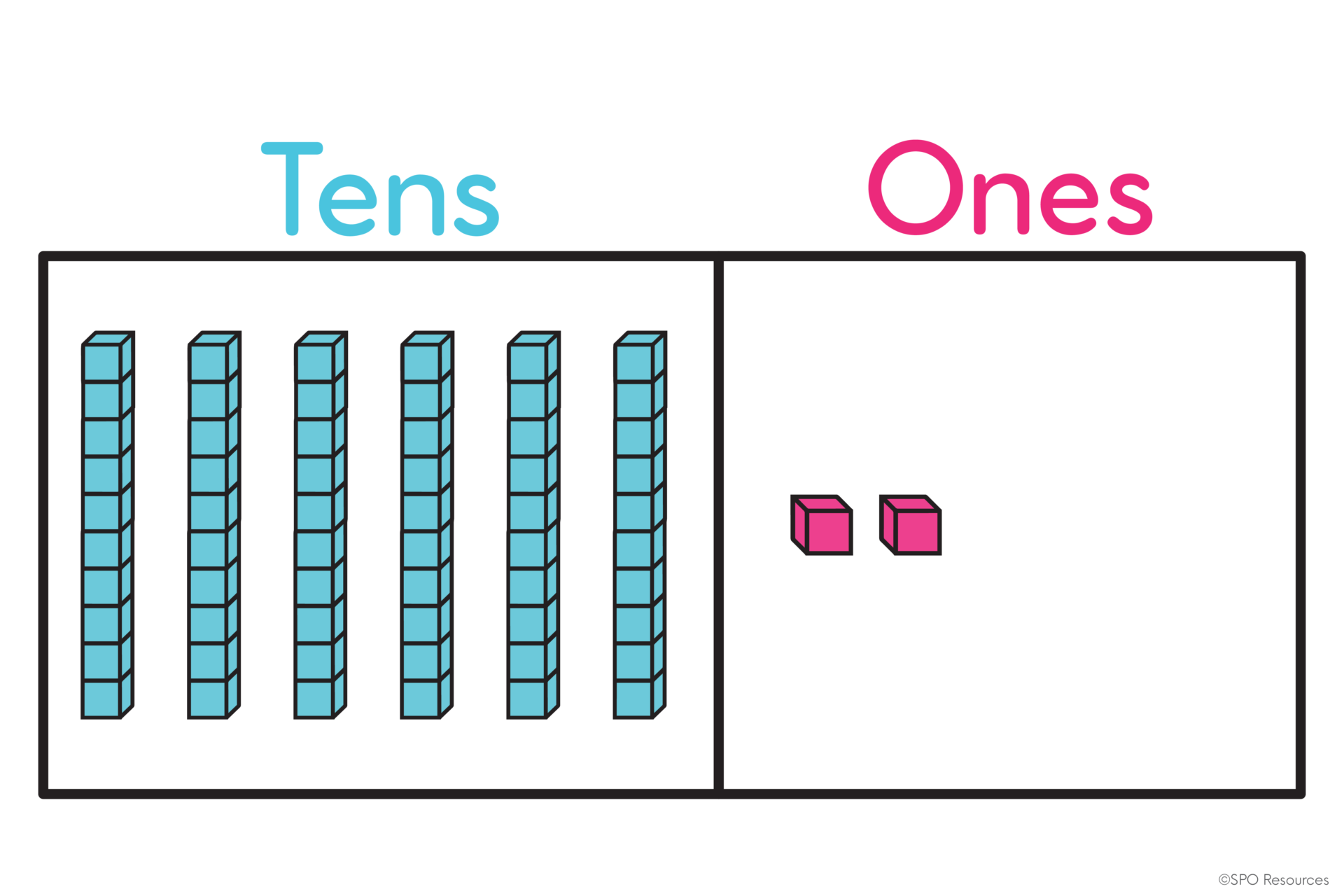
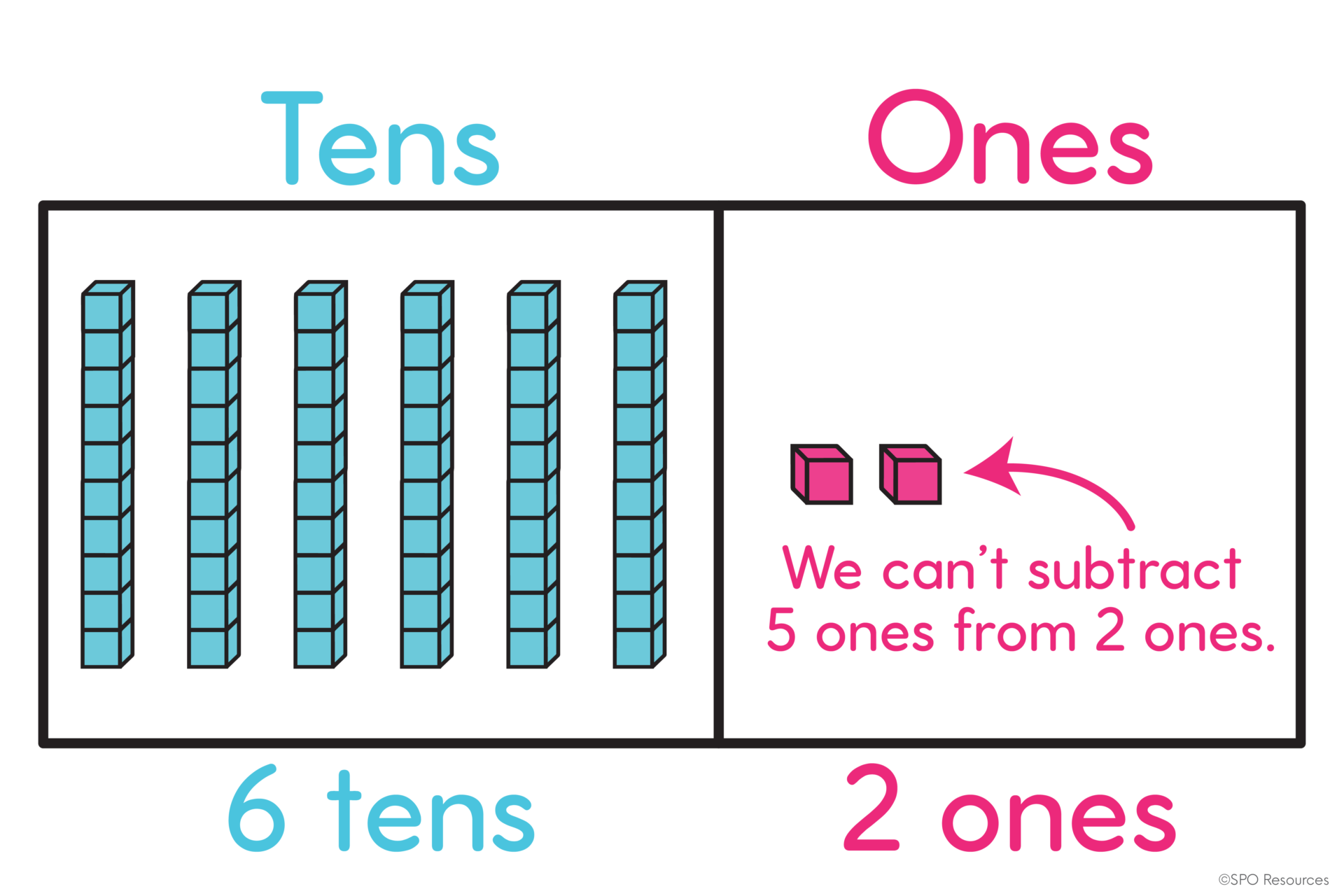
Start by representing 62 on a place value mat.
Because 62 has:
students should place 6 ten rods in the tens column and 2 one pieces in the ones column.
Before moving on, I’d have students explain what they built.
You might ask:
“How do these blocks show 62?”
Now we need to subtract 25.
Start in the ones place.
We have 2 ones, but we need to subtract 5 ones.
Here is the moment I really want students to notice.
There are only two ones sitting in front of them. They do not have enough ones in the model to take five away.
Instead of immediately telling them what to do next, I might ask:
“We have 2 ones. Can we take 5 ones away?”
If needed, point directly to the two one pieces.
Sometimes physically seeing those two pieces makes the problem much more obvious than looking at a written 2 − 5.
“So what can we do when we don’t have enough ones to subtract?”
Since we do not have enough ones, we can go to the tens place and regroup one ten.
Take one of the six tens out of the tens column.
That ten does not disappear. We are decomposing it into 10 ones.
Move those 10 ones into the ones column.
Now our model has:
Pause here and check that students understand what actually changed. I might ask:
“How many tens do we have now? How many ones? Did the value of 62 change, or did we just change how we’re representing it? How do you know?”
We still have 62. It just looks different.
Before moving on, I’d want students to be able to explain that 62 can be represented as 6 tens and 2 ones or as 5 tens and 12 ones.
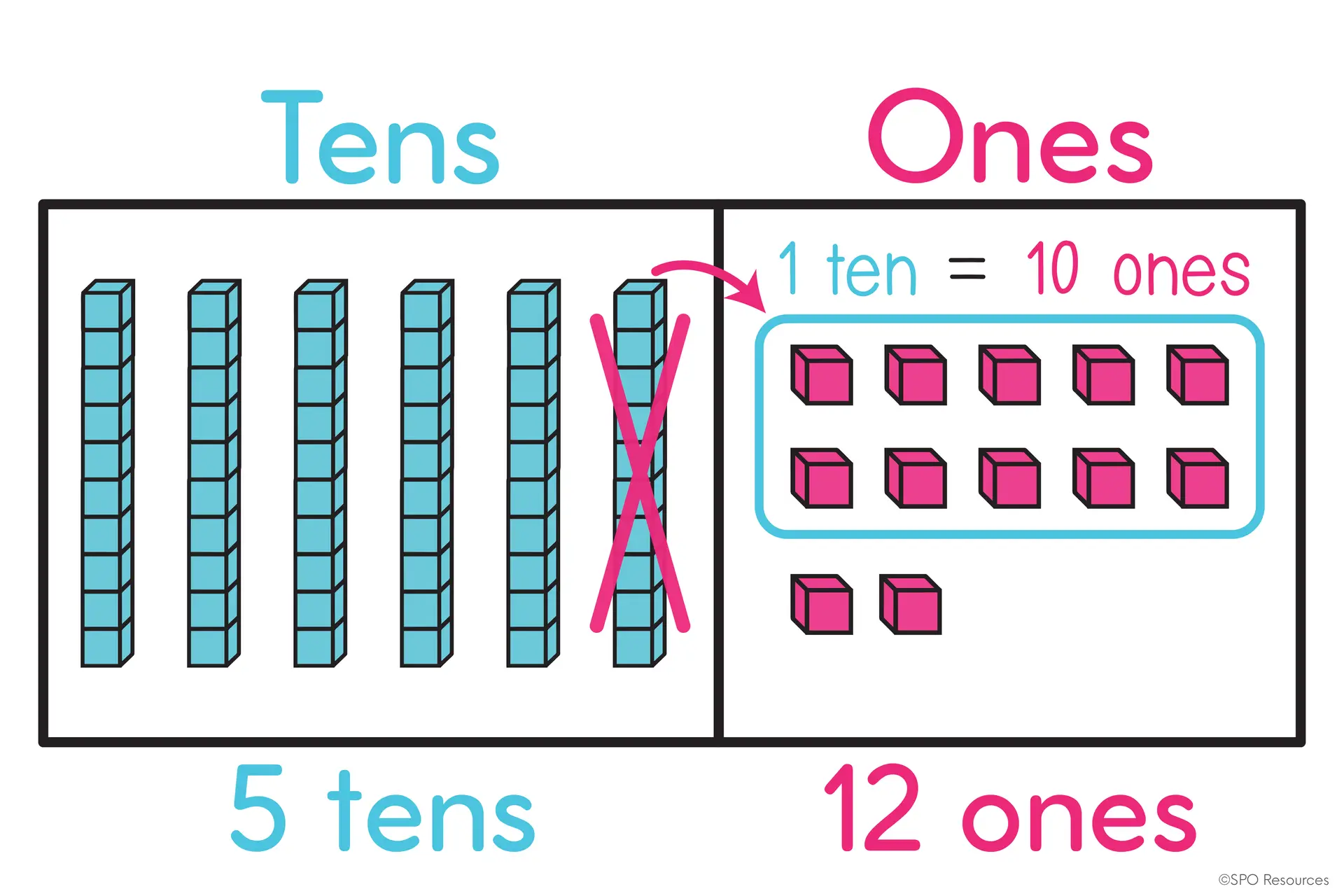
Now that we have 12 ones, we can subtract 5 ones.
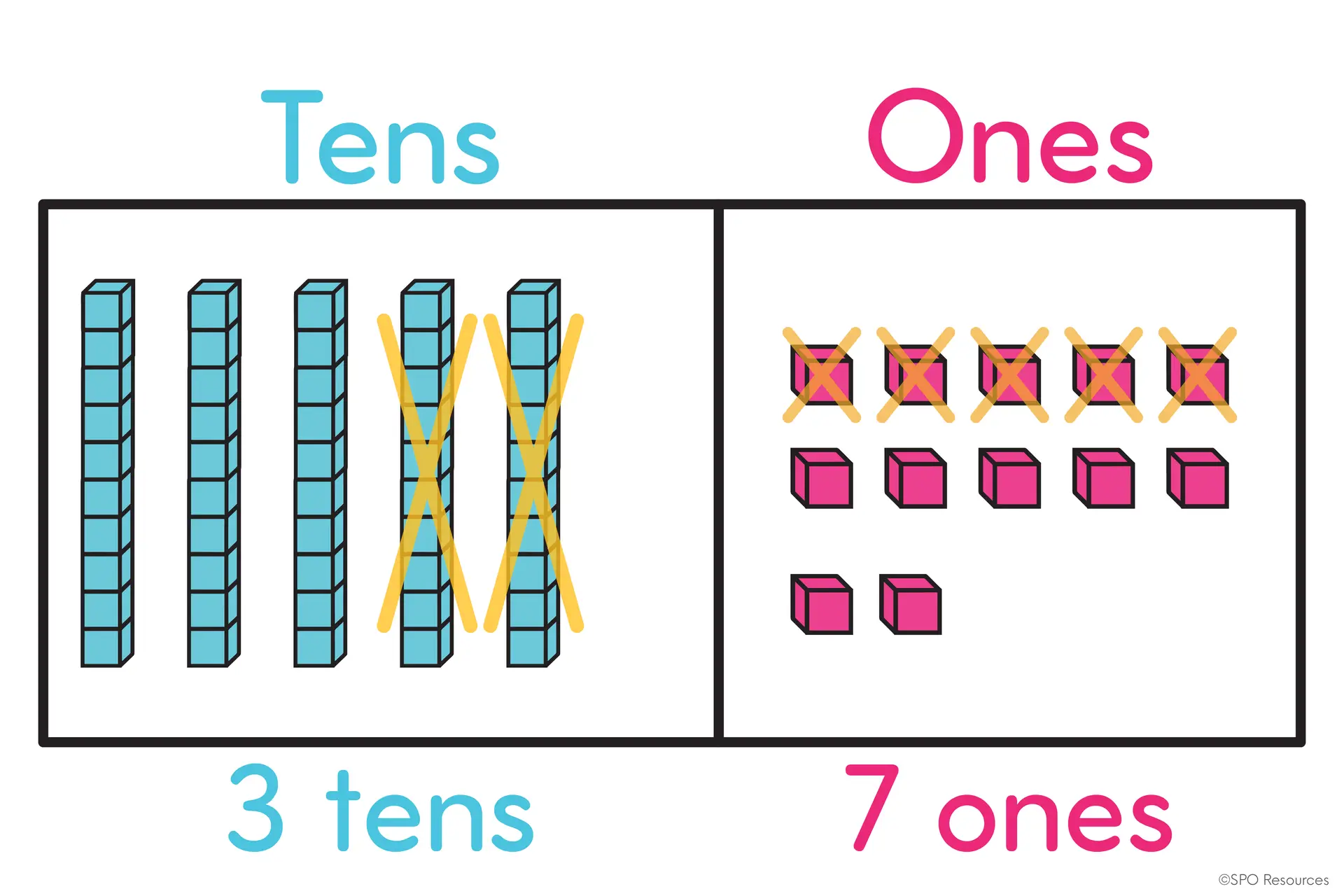
12 − 5 = 7
Remove five one pieces from the model.
There should be 7 ones left.
Write 7 in the ones place of the answer.
Next, move to the tens column.
We have 5 tens left, and we need to subtract the 2 tens in 25.
5 tens − 2 tens = 3 tens
Remove two ten rods.
You are left with:
So:
62 − 25 = 37
You can have students check that their base-ten model matches their answer. Three tens and seven ones represent 37.
Once students can explain the regrouping with the blocks, I’d put the written problem beside the model and connect the two.
Originally, we had 6 tens.
But we took one of those tens and regrouped it into 10 ones. That means we no longer have 6 tens. We have 5 tens.
In the standard algorithm, we can cross out the 6 and write a 5 above it.
Then look at the ones place.
We originally had 2 ones. We added the 10 ones that came from the regrouped ten.
10 ones + 2 ones = 12 ones.
So we can cross out the 2 and write 12.
Now the written problem matches the base-ten model:
If you learned subtraction the way many of us did, you may remember being told to “borrow” a ten. I try to use regroup or decompose instead. We aren’t borrowing a ten and giving it back later. We’re decomposing 1 ten into 10 ones and representing the same amount in a different way.
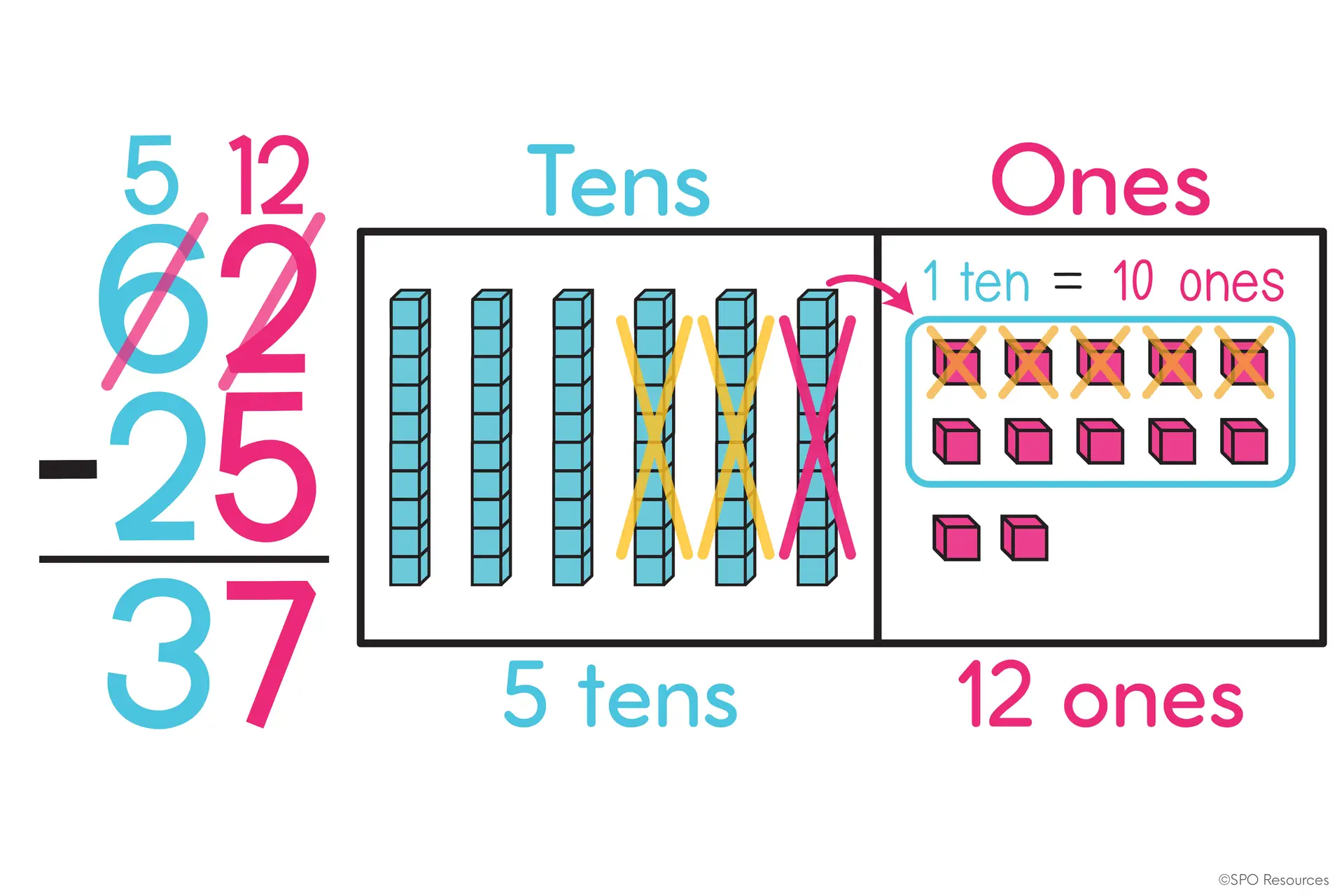
I like to let students make sense of the regrouping with the base ten blocks first. Then, while the model is still in front of them, I put the standard algorithm beside it and connect each change.
They don’t have to meet both representations at the exact same moment. What matters is that the blocks and the written algorithm don’t become two unrelated procedures. Students should be able to point to what happened in the model and explain why the numbers changed in the algorithm.
The What Works Clearinghouse also recommends helping students connect what they do with the blocks to the written math.
If students can complete the standard algorithm correctly but cannot explain what is actually happening, I’d probably bring the blocks back out and ask them to show the problem another way.
Can they model the regrouping?
Can they explain where the extra 10 ones came from?
Can they connect each change in the written problem to something they did with the blocks?
Those questions tell me more than whether they happened to get the answer right.
And if a student moves to the standard algorithm and later starts making regrouping mistakes? I’d bring the blocks back out again.
If you want to see the process modeled from beginning to end, you can watch the video above. I walk through building the number, regrouping one ten as 10 ones, subtracting with the blocks, and connecting the model to the written subtraction problem.
There are a few mistakes I’d watch for when teaching 2-digit subtraction with regrouping using base ten blocks.
A student sees:
2 − 5
and writes 3.
What they have actually done is 5 − 2 = 3. Instead of recognizing that they need to regroup, they mentally flip the digits so they can subtract the smaller number from the larger one.
Rather than immediately telling them they made a mistake, I’d ask them to explain their thinking.
“I noticed you said 2 ones minus 5 ones equals 3 ones. Can you explain how you got that?”
Then bring the model back in.
Show them two one pieces and ask:
“If I have two of these, can I take five away?”
That gives them a chance to notice the problem themselves.
Another common mistake is correctly turning the 2 ones into 12 ones but leaving the 6 tens unchanged.
The student understands that they need more ones, but they have missed where those 10 ones came from.
Go back to the model and ask:
“Where did these 10 ones come from?”
If they regrouped one of the six tens, there should only be five tens left.
The model makes that pretty hard to hide.
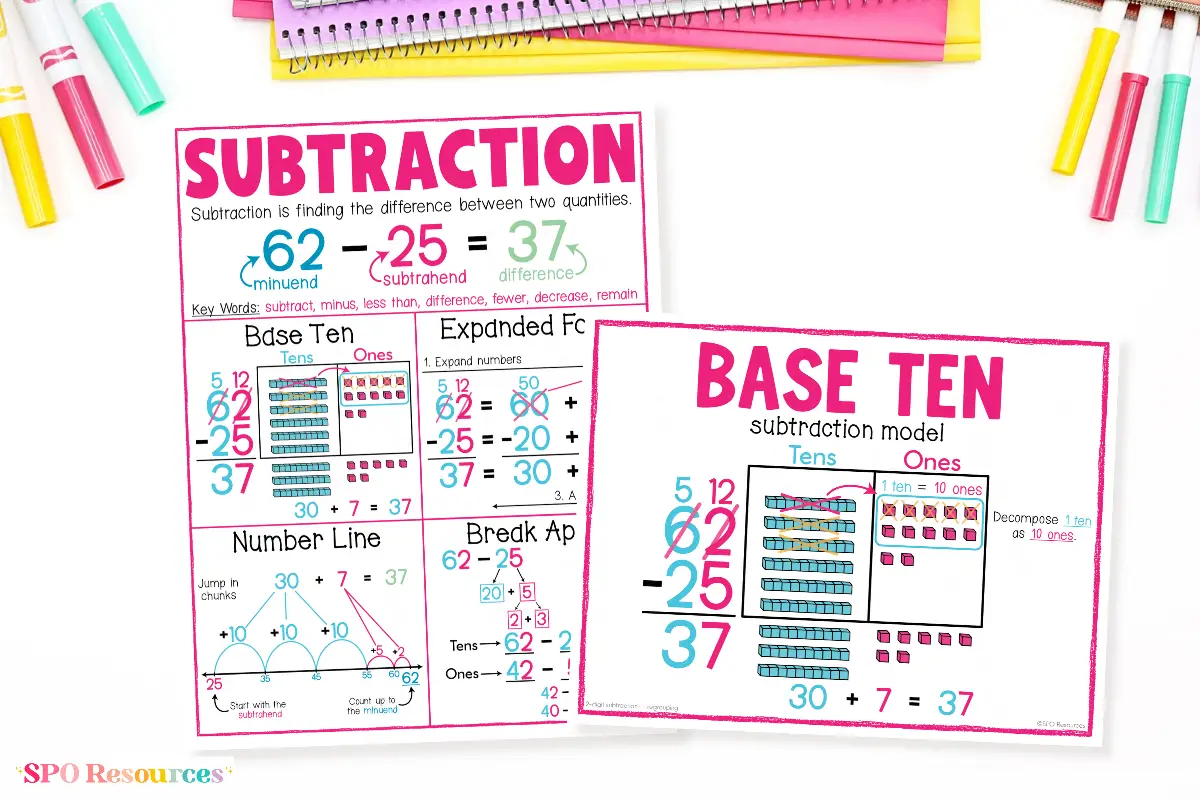
Students may understand regrouping during a lesson and still need a quick reminder when they work independently. A reference with the base-ten model beside the algorithm gives them something to check in a notebook or folder.
If you want those visuals ready to go, the Addition & Subtraction Strategy Anchor Charts and Posters include multiple strategies, including base ten blocks. You can display the full-size charts or give students smaller versions to use as they work.
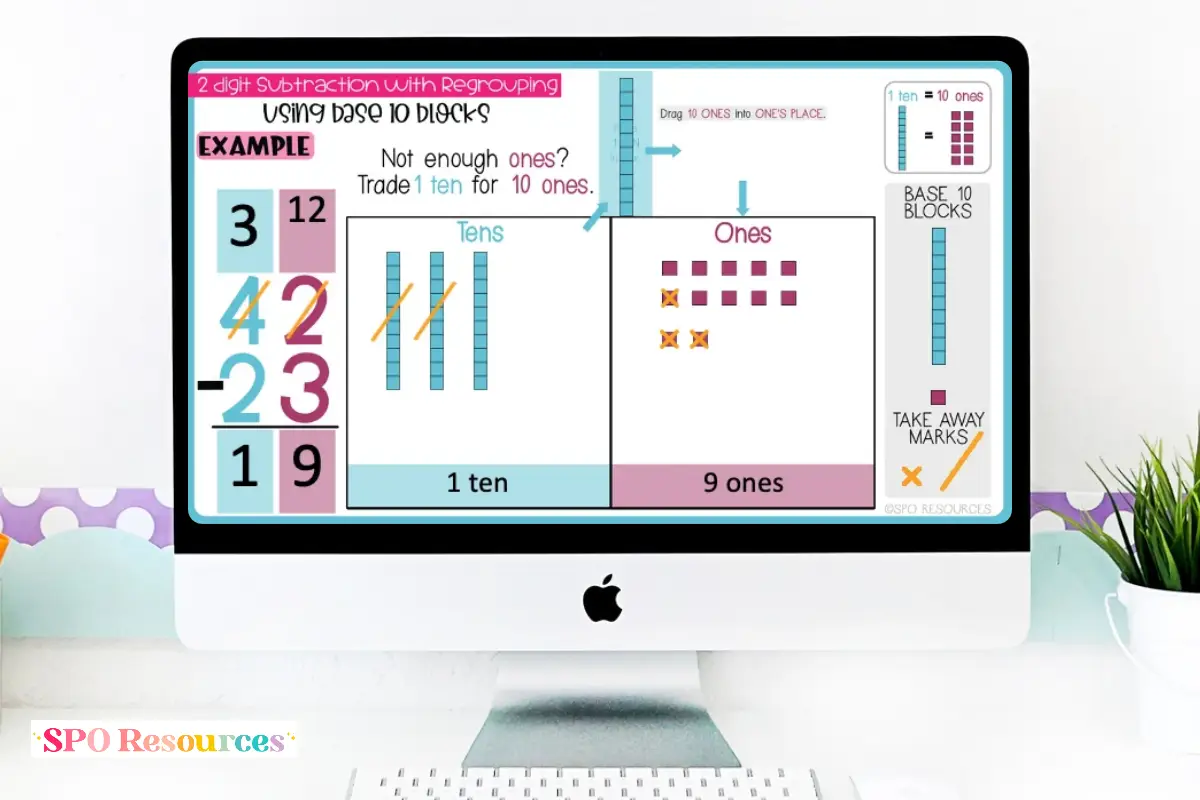
If you want students to practice the exact model we used in this post, I created a 2-Digit Subtraction With Regrouping Base 10 Blocks resource that has students work with the base-ten model and the written subtraction problem side by side.
You can display the slides while you model a problem, work through several together, use them during small group or intervention, or assign the remaining problems for independent practice.
Base ten blocks are one way to make regrouping visible, but they are not the only way students can think about subtraction.
You can also explore strategies such as expanded form, number lines, and the standard algorithm.
If a student understands 2-digit subtraction with regrouping using base ten blocks but still struggles when the blocks are removed, trying another representation may help you figure out where the disconnect is.
For me, the biggest reason to use base ten blocks for subtraction with regrouping is that students can see what the regrouping actually means.
One ten becomes 10 ones.
Six tens and two ones can be regrouped as five tens and twelve ones.
The value of the number has not changed. We have just represented it differently so that we have enough ones to subtract.
Once students understand that, the numbers they write in the standard algorithm have a reason behind them instead of feeling like a set of steps they just have to remember.

I’m a teacher, creator, designer, and lifelong learner passionate about developing engaging educational resources that save you time, lighten your workload, and inspire your students to think and learn in new ways.
Get classroom ideas, helpful resources, and exclusive freebies sent straight to your inbox.